
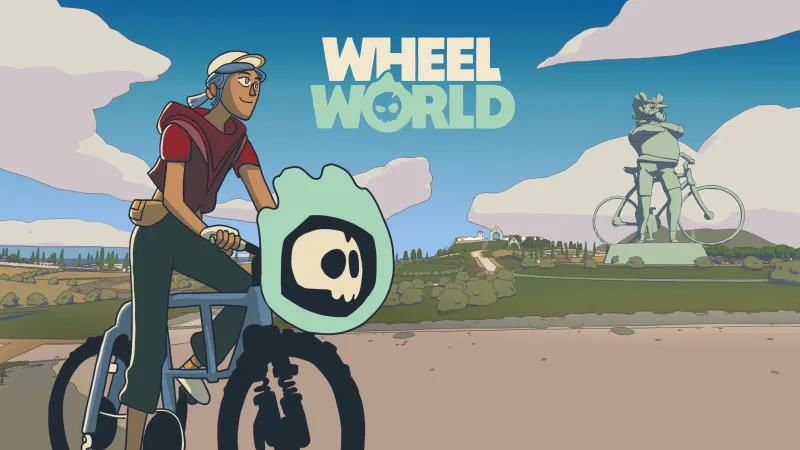
Wheel World attempts to charm players with a vibrant aesthetic, a laid-back atmosphere, and a stellar soundtrack, but the experience ultimately stalls due to repetitive gameplay, a hollow narrative, and frustrating technical flaws. Despite its promise of an inviting open-world cycling adventure, the game quickly devolves into a monotonous grind that leaves the player questioning the appeal of its own world.
The Cycle of Repetition
The story follows Kat, a cyclist who discovers a ghost bike capable of facilitating the “Great Shift”—a transition for spirits moving to the afterlife. To succeed, Kat must traverse an open world, earn reputation through races, and collect legendary parts to repair the ghost bike. This loop relies on a Ubisoft-style tower formula where players clear “bell shrines” to reveal map icons. Unfortunately, the gameplay loop is stiflingly predictable, cycling through generic races, drone-chasing side activities, and repetitive part-buying vendors.
Geographic Variety Without Mechanical Depth
While the game features visually distinct regions—ranging from Pacific Northwest-inspired forests to Tuscan-style vineyards—these environments offer little mechanical variety. Whether you are navigating dirt paths or urban architecture, the biking physics remain largely unchanged. The environmental hazards, such as vines or elevation shifts, fail to meaningfully alter the core racing experience, making the world feel like a collection of static backdrops rather than living, breathing ecosystems.
Frustrating Physics and AI Failures
The racing itself is surprisingly devoid of challenge, with AI opponents often struggling to keep pace or navigate basic obstacles. Paradoxically, the game’s difficulty comes from broken collision physics. Colliding with objects or other racers results in unpredictable outcomes—sometimes Kat bounces off harmlessly, while other times a minor nudge leads to a crash that resets the player’s position, often dropping them to last place. This disparity creates an experience that feels unfair rather than demanding.
Customization That Doesn’t Count
Wheel World places a heavy emphasis on bike customization, allowing players to swap parts to suit specific terrains. However, these adjustments feel largely superficial. A road-ready bike performs just as effectively in off-road races as a specialized build, rendering the stat-driven progression system largely irrelevant. Finding parts becomes a chore rather than a reward, as the performance impact is rarely felt on the road.
Narrative and Technical Stumbles
The game’s legendary racers, built up as the pinnacle of the cycling world, are paper-thin characters who lack any real authority or depth. Their dialogue is filled with puns and pop-culture references, but it fails to ground them in the world’s lore. This is compounded by technical issues, including erratic lighting, significant pop-in, and bizarre AI behavior during high-stakes races. The finale arrives abruptly after only four hours, feeling unfinished and lacking the narrative payoff the premise initially promised.
A Soundtrack Lost in the Static
The sole saving grace of Wheel World is its soundtrack. Curated by the independent label Italians Do It Better, the music is arguably one of the best of the year. It provides a phenomenal backdrop that elevates the legendary races, yet it serves as a bittersweet highlight; it is a high-quality production trapped within a game that fails to harmonize with its own brilliance.
Ultimately, Wheel World is a collection of wasted potential. Its striking art style and incredible audio cannot compensate for the clumsy physics, shallow storytelling, and the pervasive sense of boredom that sets in long before the credits roll. By the time the finish line is crossed, the game leaves the player with little sense of accomplishment, only the desire to step off the bike for good.