
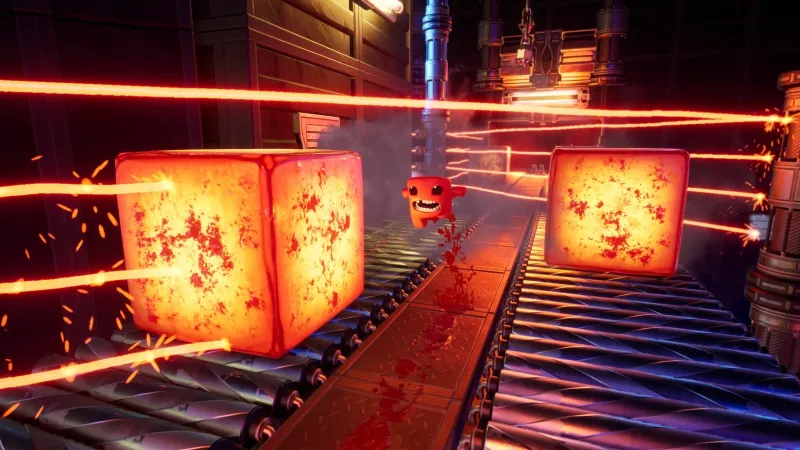
Team Meat’s transition of the iconic Super Meat Boy into a 3D environment delivers a polarizing experience that bridges the gap between the precision of Mario and the inconsistent mechanics often found in 3D platformers. While the game successfully captures the series’ signature tight controls and brutal difficulty, the shift to a 3D perspective creates occasional, frustrating clashes between the player’s spatial awareness and the fast-paced nature of the gameplay.
Precision Platforming in a New Dimension
Super Meat Boy 3D utilizes a linear 2D framework enhanced with depth, allowing players to move freely toward and away from the screen. The camera shifts dynamically—ranging from isometric angles to traditional sidescrolling and behind-the-character views—to keep the action fresh. The core mechanics remain remarkably intact; sprinting, wall-jumping, and sliding through hazardous traps feel as responsive and satisfying as they did in the 2010 original. The forgiving respawn system remains a highlight, effectively mitigating the frustration of the game’s high-stakes difficulty.
The Thrill of the Challenge
When the gameplay loop hits its stride, Super Meat Boy 3D is exhilarating. Players must navigate spinning buzzsaws and spiked floors with split-second reactions, creating a flow state that few platformers achieve. Reaching Bandage Girl—only to see her promptly abducted by Dr. Fetus—provides that familiar, rewarding rush. The inclusion of instant respawns encourages experimentation, and the post-level replay featuring dozens of “Meat Boy clones” serves as a satisfying visual testament to the player’s persistence. Furthermore, earning an A+ rank unlocks the “Dark World” variants, offering a masochistic, albeit welcome, escalation in difficulty for dedicated fans.
Depth Perception and Camera Hurdles
Despite the high-octane fun, the move to 3D introduces a persistent, recurring headache: depth perception. Certain camera angles, combined with a zoomed-out perspective, make it difficult to gauge landing zones accurately. While a red ring beneath Meat Boy helps track vertical landings, it fails to provide adequate feedback for forward horizontal movement. In a game where standing still for even a second usually results in death, the lack of a free-roaming camera makes adjusting to these odd, fixed angles during high-speed sequences feel unnecessarily punishing.
The Verdict on Team Meat’s Latest
Boss battles are similarly hit-or-miss. While most are succinct and inventive, encounters like the rat chase mission highlight the game’s struggle with spatial orientation. Additionally, the soundtrack feels like a missed opportunity, featuring a collection of uninspired metal tracks that fail to capture the zany, blood-soaked energy of the Meat Boy universe. Ultimately, Super Meat Boy 3D proves that Team Meat’s formula can thrive in a 3D space, but it requires further refinement to reach the legendary status of its 2D predecessor. Despite the perspective-induced frustrations, the addictive “just one more try” loop ensures players will keep coming back for more.