
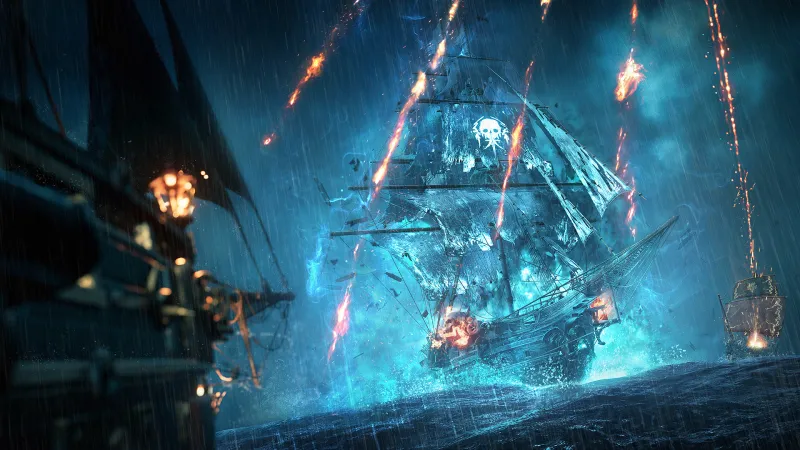
After a tumultuous development cycle marked by numerous delays and shifting directions, Ubisoft’s Skull and Bones has finally set sail. While the game faces challenges common to live-service titles, it succeeds as a surprisingly deep pirate adventure, offering a rich commerce simulation and a rewarding naval combat loop that proves there is gold to be found in these digital waters.
The Life of a High-Seas Buccaneer
Players begin their journey as an ambitious pirate seeking infamy across the Indian Ocean. The gameplay loop centers on hunting for treasure, plundering coastal settlements, and engaging in intense naval warfare. Unlike other open-world titles, on-foot exploration is limited to social hubs and brief narrative moments; the heart of the experience remains firmly on the deck of your ship, where you transform modest vessels into engines of destruction.
Naval Combat and Ship Progression
Drawing inspiration from the maritime foundations of the Assassin’s Creed series, Skull and Bones excels in its pacing. Exploring the vast, beautifully rendered Indian Ocean—complete with sea shanties, breaching whales, and treacherous riverways—is a highlight. Combat requires tactical precision, forcing players to balance speed, positioning, and aim while bracing for incoming fire. The depth of customization is equally impressive; chasing the next upgrade for your ship provides a persistent sense of progression, with a map system that clearly marks where to source specific materials.
Cooperative Play and Commerce
The game primarily focuses on PvE encounters, allowing players to tackle privateers and merchant fleets solo or in groups. While PvP is available, the community often leans toward cooperative play, with players frequently assisting one another during battles. Beyond combat, the game’s commerce system adds a layer of economic strategy. Players can engage in simple trade or dive deep into the illicit smuggling of rum and opium. As you reach the endgame, the experience evolves into an empire-building simulator, allowing for passive income generation through factories and lumberyards.
The Challenges of the Open Sea
Despite its strengths, Skull and Bones is not without its hurdles. The charm of early-game exploration eventually gives way to repetitive mission design, and the restrictive fast-travel system—limited only to ports—often turns long voyages into a chore. The progression system can also feel unbalanced; it is common to find yourself either significantly over-leveled or under-leveled for specific encounters, which strips away the tension of combat.
Narrative and Long-Term Potential
Storytelling remains a weak point, with sparse narratives and one-dimensional characters. The silent, customizable protagonist lacks the charisma typically associated with classic pirate tales. However, the endgame loop—comprising sea monster hunts, large-scale team-up activities, and ongoing ship customization—shows promise. While the game is currently a flawed experience, its solid foundations and the promise of seasonal updates suggest that Skull and Bones has the potential to evolve into a premier pirate fantasy, provided Ubisoft continues to refine the experience in the months to come.