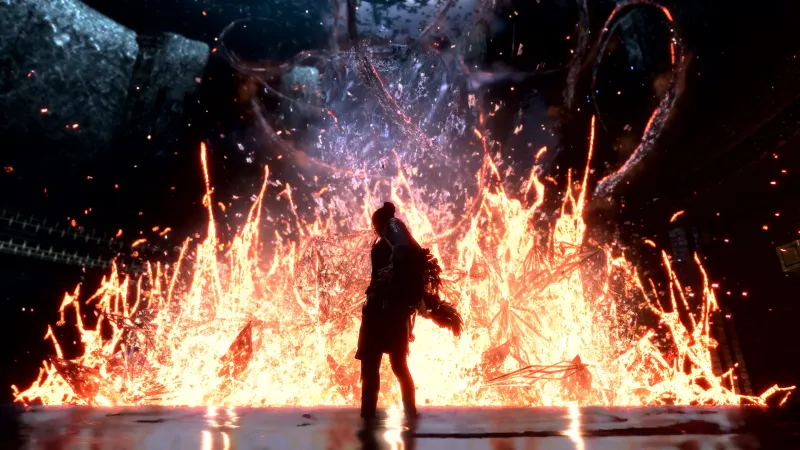

Silent Hill f marks the franchise’s triumphant return after 13 years, delivering a standalone psychological horror experience that masterfully blends visceral combat with a deep, symbolic narrative exploring gender roles, societal expectations, and the harrowing transition into adulthood.
A Dreamlike Descent into Psychological Horror
Immersing yourself in Silent Hill f is like drinking a powerfully fragrant tea steeped in bloody metaphor and symbolism. The game satisfyingly eschews surface-level storytelling through its various twists and turns. As if retreating into its own mysterious fog, f isn’t easy to fully understand at first. Various plot threads and themes intersect and overlap in a dreamlike fashion. By the game’s ending (of which there are multiple), I had so many questions that weren’t answered–in a good way. I walked away unsure of what I had experienced, where the metaphors began and ended, and just what exactly happened in this sleepy mountainside village. Silent Hill f is a gorgeous and exquisite work of psychological horror that had me desperate to relive its narrative again after the credits rolled.
In its moment-to-moment gameplay, Silent Hill f challenges you to fight or evade various horrifying monsters, solve cryptic puzzles, and attempt to piece together a complicated, bi-directional narrative of resistance and submission. The game takes big risks in its relocation to a new setting and its slightly more action-focused combat, but these elements pay off, delivering a shellshock of a horror experience that is as resonant as it is terrifying.
The Nightmare of Ebisugaoka
Set in a fictional rural Japanese mountainside village called Ebisugaoka during the 1960s, the story centers on the experience of living as a woman in a society that values her only for her potential to be married. You play as Hinako Shimizu, a teenager who finds herself at odds with the rigid expectations imposed by her family and community.

After a bitter argument with her parents, Hinako ventures out to find her village overtaken by a thick, oppressive fog, fleshy floral overgrowths, and contorted mannequins wielding kitchen knives. As she attempts to escape this hellscape, she is joined by three friends—Sakuko, Rinko, and Shu—while encountering a mysterious, charming figure known only as Fox Mask.
Fluid Combat Meets Survival Dread
Unlike previous protagonists, Hinako is remarkably nimble. While this shift toward more action-oriented gameplay initially felt discordant, it quickly proves its worth. The combat is fluid and snappy, utilizing a stamina-based system for dodging and attacking, yet it never loses the essential vulnerability required for survival horror.

Weapon degradation and scarcity keep the tension high; you are rarely an “elite soldier.” You must choose your battles wisely, as fighting every monster you encounter is a fast track to failure. The game also incorporates a “Sanity” meter, allowing for “Focus” moves, and offers “omamori” items to augment Hinako’s abilities, providing a welcome layer of customization for different playstyles.

Whether you choose “Story” or “Hard” difficulty for combat and puzzles, the experience remains intense. The sound design—filled with moans, clanking, and that signature, satisfying static—serves as a constant, chilling reminder that you are never truly safe.
Masterful Puzzles and Narrative Depth
True to the series’ roots, the puzzles in Silent Hill f are intricate, requiring more than just brute force. They are beautifully designed, often forcing you to rely on clues found in your journal or the environment. The narrative, meanwhile, is best experienced firsthand. It refuses to be easily digested, weaving together themes of cultural tradition, physical trauma, and the crushing weight of societal judgment.

The game’s gore is never frivolous; it serves the narrative’s exploration of violence and repression. The Dark Shrine segments, in particular, evoke a sense of empowerment that is simultaneously a warning of impending doom. The story remains unpredictable, often subverting tropes of rebellion to explore more nuanced themes of commitment and identity.

A World Built on Folklore and Fog
Worldbuilding is expertly handled through environmental storytelling and collectible notes. From etiquette magazines to meditations on kitsune no yomeiri (fox weddings), these documents flesh out a 1960s Japan caught between agrarian tradition and creeping modernization.

Silent Hill f is an ambitious, successful evolution of the franchise. It captures the classic gloom and psychological struggle of the series while carving out its own distinct identity. It is a haunting, beautiful, and deeply unsettling experience that demands to be played, replayed, and debated long after the final credits roll.