
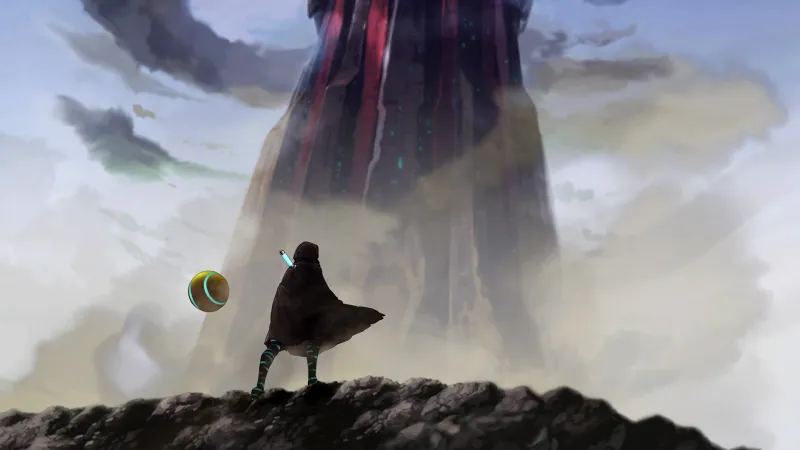
Shadow Labyrinth attempts an ambitious fusion of Pac-Man mechanics with the Metroidvania genre, but ultimately suffers from a bloated 40-hour runtime, disjointed storytelling, and inconsistent design choices that hinder the overall experience.
The Puck Problem: Mechanical Friction
Your primary companion is Puck, a limbless robot resembling Pac-Man who brings you to life to fight for a mysterious cause—a plot point that remains opaque for several hours. You occasionally take control of Puck, a segment that shifts the gameplay into a magnet-based platformer where she automatically glides along blue-light rails. While the game provides a trajectory preview and a brake button, controlling Puck feels inherently uncomfortable. Combat during these segments is particularly clunky; her only attack involves launching a spinning blade, which frequently leads to accidental damage as it is difficult to strike enemies without colliding with them yourself. Though these sections occupy only about 15 percent of the game, they rarely feel rewarding.
Combat and the G.A.I.A. System
Beyond the standard gameplay, the G.A.I.A. meter allows for a temporary transformation into a hulking mech. This form serves as a highlight, offering immunity to environmental hazards like spikes and providing a satisfying, high-damage output that acts as a climactic finisher during intense encounters. Once you unlock a full suite of movement and combat abilities later in the game, the core loop becomes a serviceable dance of parrying, dodging, and managing your ESP meter. However, the path to reaching this level of depth is unnecessarily protracted.
A Story and Aesthetic Mismatch
The game’s sci-fi narrative attempts to tackle an intergalactic war, but the execution falls flat. The story is overly complex, relying heavily on exposition rather than organic storytelling, resulting in forgettable plot beats shrouded in bizarre aesthetics. This lack of cohesion extends to the visuals; character models are densely packed with indecipherable details that clash sharply with the painterly, sometimes blurry backgrounds. The Bosconian village stands as a prime example, where the over-designed inhabitants feel completely detached from their environment.
Structural Flaws and Pacing Issues
Shadow Labyrinth is a victim of its own length. Requiring 30 to 40 hours to complete, the game forces players to wait far too long for fundamental mechanics. Essential skills like parrying and blocking are gated behind boss fights five to seven hours into the campaign, long after players have mastered the basics. Conversely, critical mobility tools like the double jump or ground pound are easily missed, and the sparse checkpoint system makes the inevitable backtracking a tedious chore.
A Disappointing Finale
The experience concludes on a sour note, marked by a massive, sudden difficulty spike and a relentless gauntlet of multi-phase boss fights. This final sequence effectively kills any momentum the game had built, serving as a frustrating end for both the narrative and the mechanical progression. Ultimately, Shadow Labyrinth feels like a unfocused project that fails to satisfy Pac-Man fans or Metroidvania enthusiasts, leaving little reason to endure its 40-hour journey.