

Roblox is rolling out a suite of agentic AI features designed to streamline the game development lifecycle, enabling creators to plan, build, and test experiences more efficiently through its revamped Roblox Assistant. The platform is moving beyond simple text-to-output prompts to provide a more collaborative, multi-step development environment.
Transforming Development with Planning Mode
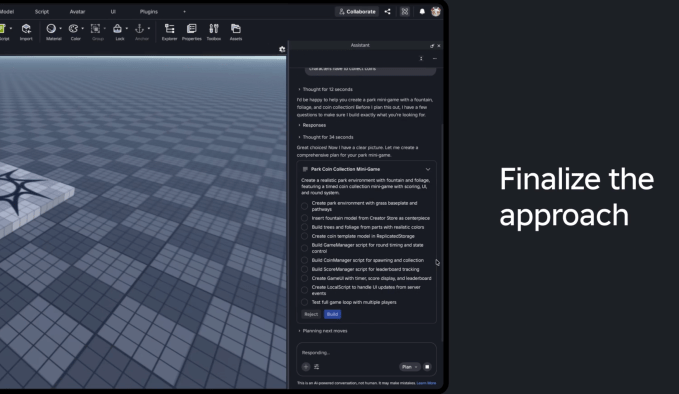
Recognizing that single-step AI prompts often fail to capture a creator’s nuanced vision, Roblox is introducing an enhanced “Planning Mode.” This tool turns the Assistant into a collaborative partner capable of analyzing game code and data models. It actively engages developers by asking clarifying questions and translating abstract ideas into actionable, editable development plans.
Planning Mode allows creators to refine their approach before implementation. For instance, if a user requests a “park mini-game with a fountain and foliage,” the Assistant will now probe for specific aesthetic preferences—such as fantasy or realistic styles—and offer options for asset creation, ranging from custom builds to existing items from the Creator Store.
Advanced Asset Generation Tools
Once a plan is finalized, the Assistant leverages two new AI capabilities: Mesh Generation and Procedural Model Generation. Mesh Generation allows developers to bypass low-quality placeholders by creating high-fidelity, fully textured 3D objects directly within the game world. This accelerates the prototyping phase significantly.
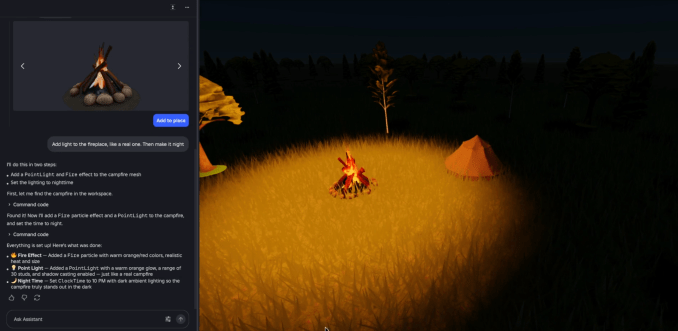
Furthermore, “Procedural Models” will soon enable creators to generate editable 3D objects via code and natural language prompts. Because the AI understands spatial and physical relationships, creators can scale and place objects dynamically—adjusting specific attributes like staircase height or the number of shelves in a bookcase—creating a library of reusable, editable building blocks.
Self-Correcting Development Loops
Nick Tornow, SVP of Engineering at Roblox, noted that these agentic features bridge the gap between creative vision and technical execution. The Assistant now functions as a multi-step partner that not only builds but also tests.
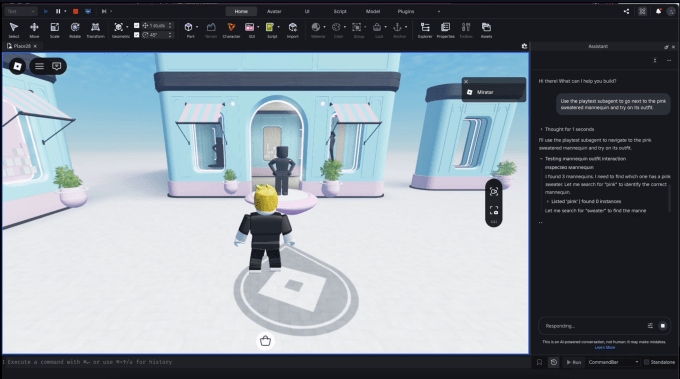
During the testing phase, the system reads output logs, captures screenshots, and simulates player inputs (keyboard and mouse) to identify bugs. It then autonomously provides feedback to the Assistant to implement fixes. As explained in a blog post, this creates a self-correcting system that improves in accuracy over time.
Looking ahead, Roblox is working to enable multiple AI agents to collaborate in parallel, handle complex cloud-based workflows, and manage tasks like character creation and advanced coding. The company also remains committed to interoperability, ensuring creators can integrate third-party tools like Claude, Cursor, and Codex directly into the Roblox Studio workflow.