
Obsidian Entertainment delivers a narrative triumph with Pentiment, an adventure game that masterfully fuses historical depth, unique art direction, and branching player choice. Set in the 16th-century Holy Roman Empire, the game functions as a living manuscript, tasking players with uncovering dark truths in the fictional town of Tassing. Despite minor pacing inconsistencies, it stands as an essential experience for fans of narrative-driven games.
The Life and Times of Andreas Maler
The story follows Andreas Maler, a traveling artist stationed in Tassing in 1518. While Andreas spends his days crafting masterpieces and transcribing local abbey manuscripts, he quickly finds himself embroiled in a web of local conspiracies. Players can customize Andreas’s background—choosing between theological scholarship, legal studies, or hedonistic pursuits—which subtly alters the dialogue options available throughout his journey.
Murder, Mystery, and Moral Weight
Pentiment shines brightest during its murder mystery segments, which span the game’s first two acts. Time is a finite resource; players must choose how to spend their limited hours, whether by sharing meals with suspects or investigating ruins. The game forces you to identify a culprit based on incomplete information, leaving you to live with the heavy consequences of your accusations. The town of Tassing acts as a living character, evolving over the years as babies are born, the elderly pass on, and the political landscape shifts based on your past decisions.
A Living Manuscript Aesthetic
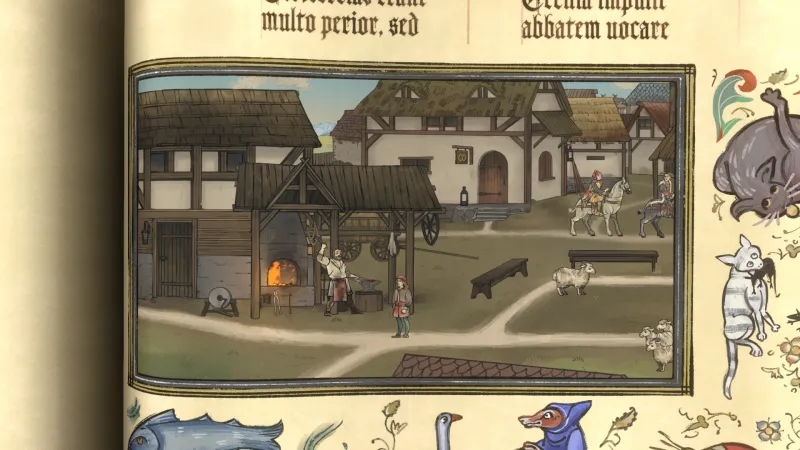
The game’s charm is rooted in its book-like presentation. From the moment you begin, you are essentially watching a story being penned in real-time. Characters and environments are rendered as era-specific illustrations, and the game’s menu functions as a glossary, allowing players to instantly look up historical terms. This commitment to the theme extends to the dialogue, which eschews voice acting in favor of distinct, personality-driven fonts that represent a character’s social status—ranging from the ornate script of the abbey brothers to the simple cursive of the common folk.
Pacing and Audio Hurdles
While the visual storytelling is sublime, the game’s pacing occasionally falters. The slow buildup to the first murder, combined with a dip in momentum during the third act, may test the patience of some players. Furthermore, the audio design can feel sparse. The lack of a consistent musical score makes long conversations feel awkward, occasionally punctuated by repetitive environmental sounds like sweeping, which can become distracting during extended dialogue sequences.
A Lasting Impression
Despite these minor gripes, Pentiment remains a remarkably unique experience that treats its historical setting with profound respect. It is a game about how history is recorded, distorted, and passed down through generations. By the time the credits roll, the struggles of Andreas Maler and the residents of Tassing will likely linger in your mind, much like the ink on the pages of the very book you helped write.