
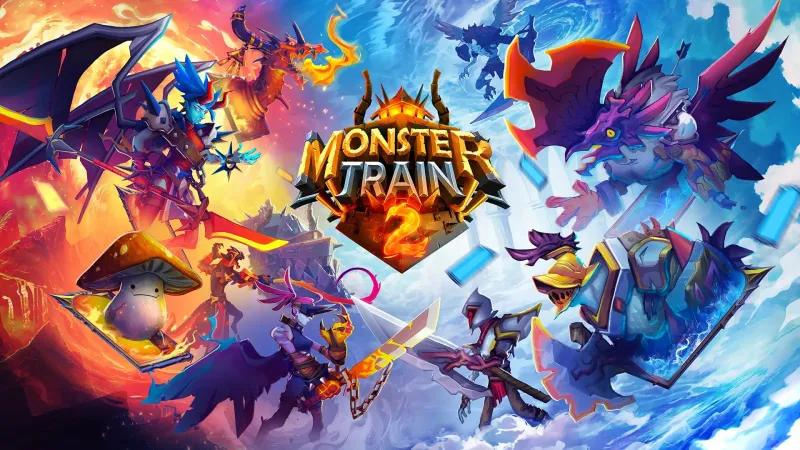
Shiny Shoe has officially redefined the genre with Monster Train 2, a sequel that refines its predecessor’s mechanics to deliver one of the most satisfying roguelike experiences of the year. By introducing five new Clans, innovative card types, and a robust set of dimensional challenges, the developer has ensured that while every run feels distinct, the strategic combat remains consistently rewarding.
Strategic Warfare Against the Titans
In Monster Train 2, players command various armies of Hell to halt the advance of the Titans, an ancient, formidable faction threatening the world’s existence. You choose from a variety of unique Clans, each defined by specific magical creatures and playstyles. The angelic Banished Clan, for instance, utilizes the Valor buff to bolster armor and damage, while the draconic Pyreborn Clan focuses on gold hoarding and the “pyregel” debuff to amplify enemy damage taken. With two distinct champions available per Clan and a massive array of primary and secondary combinations, the sheer depth of gameplay variety is staggering.
Mastering the Locomotive
Combat unfolds aboard a four-tiered locomotive. Three tiers serve as battlegrounds for your units, while the fourth houses the Pyre—the train’s lifeblood. Protecting the Pyre is paramount; if it falls, your run ends. The game masterfully blends deckbuilding, roguelike elements, and tower defense, requiring players to draft cards to deploy units and defend against relentless waves of attackers.
New Mechanics: Equipment and Room Cards
While standard spellcasting remains central to the experience, Monster Train 2 introduces two game-changing mechanics: equipment and room cards. Equipment allows you to enhance friendly units with superior stats and abilities, while room cards apply modifiers to entire train cars, such as boosting spell potency or generating gold upon unit death. Furthermore, the inclusion of unlockable Pyres—each with unique active or passive abilities—adds a layer of tactical customization that integrates so naturally it feels like a staple feature of the series.
Unmatched Run Variety
With 80 potential starting combinations—excluding the game’s numerous secret clans—Monster Train 2 avoids the trap of repetitive randomness. Every synergy feels intentional and exciting. Whether you are experimenting with starting cards or optimizing unit placement, the game rewards strategic thinking rather than relying on luck, maintaining a high level of engagement across every session.
Dimensional Challenges: Curated Complexity
Beyond the standard campaign, the game features 21 Dimensional Challenges. These curated modes restrict you to specific Clan combinations while applying unique mutators. Challenges like “Weapons Make the Warrior” or “Twofer” force players to adapt their strategies in ways that go beyond simple difficulty scaling. It is a refreshing approach that offers meaningful variety for players looking to test their skills under specific, thematic constraints.
Narrative Shortcomings
The game’s primary weakness lies in its narrative delivery. Cutscenes featuring conversations between Champions feel underdeveloped, often relying on reused battle models against static, uninspired backgrounds. The dialogue frequently serves as clunky exposition, reducing complex characters to one-dimensional tropes. Fortunately, these segments are infrequent and easily bypassed, allowing the stellar gameplay to remain the focus.
Ultimately, Monster Train 2 is not a title defined by its story, but by its tense, strategic combat and the addictive loop of optimizing spells and units. In a crowded indie market, this sequel stands out as a definitive leader in the roguelike genre. It is a polished, expertly crafted experience that proves the series is still at the top of its game.