
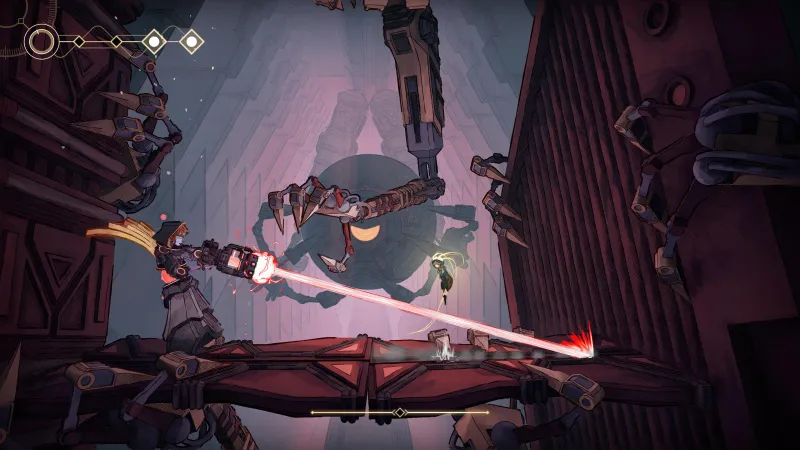
Mio: Memories in Orbit casts players as a fragile, amnesiac robot awakening aboard a decaying starship, tasked with saving her world while struggling to maintain her own structural integrity. Developed in the vein of challenging search-action titles like Ori and Hollow Knight, the game is a masterclass in meticulous level design and atmospheric aesthetics, though its punishing difficulty curve may prove polarizing for the average player.
A Test of Persistence and Precision
Every inch of progress in Mio is hard-won. The game balances its rewarding exploration with significant hurdles, ranging from intricate precision-platforming segments to unforgiving boss encounters. Players may spend hours grinding for a single health upgrade, only for the narrative to strip those gains away as Mio weakens. With sparsely placed checkpoints and a lack of difficulty assists, death is a constant companion. Furthermore, the game’s navigation can be opaque; rather than clear signposting, players are often forced to backtrack to obscure corners of the map to utilize new upgrades, leading to extended periods of aimless wandering.
The Fine Line Between Mastery and Frustration
While this unforgiving structure fosters a sense of deep mastery, it frequently veers into tedious territory. The insistence on replaying conquered sections to reach a new challenge can feel less like a test of skill and more like a deliberate attempt to infuriate the player. At times, the game’s design choices prioritize friction over engagement, which ultimately undermines the experience.
A Visual and Auditory Triumph
Despite its frustrations, Mio is undeniably captivating. Its watercolor backdrops breathe life into the ruined vessel, complemented by a haunting, minimalist score that blends ambient textures with melancholic choral harmonies. Navigation feels fluid thanks to versatile upgrades like wall-climbing and double-jumping, while combat demands absolute focus—requiring quick reflexes to counter telegraphed enemy attacks. The map itself functions as an intricate puzzle, culminating in a late-game twist that recontextualizes the sprawling corridors and elevators.
The Anti-Power Fantasy
Progression in Mio eschews the typical “power fantasy” arc. Instead of becoming an unstoppable force, players are granted tactical flexibility. The game utilizes a trade-off system; for instance, equipping a health boost might require sacrificing combo damage, or viewing an enemy’s health bar might disable your own HUD. Even as the credits roll, Mio remains small and vulnerable. This design choice highlights her fragility and makes her eventual journey toward saving the ship feel significantly more impactful.
Narrative Ambiguity and Final Verdict
The narrative remains sparse, leaving many questions unanswered. While the core themes of loss and sacrifice resonate, the development of relationships and the primary antagonist feels somewhat hollow and unearned. For those who crave high-stakes platforming and relentless exploration, Mio is a must-play that belongs at the top of your list. However, for those seeking a more accessible experience, the game’s demanding nature may often feel more like a chore than a satisfying adventure.