
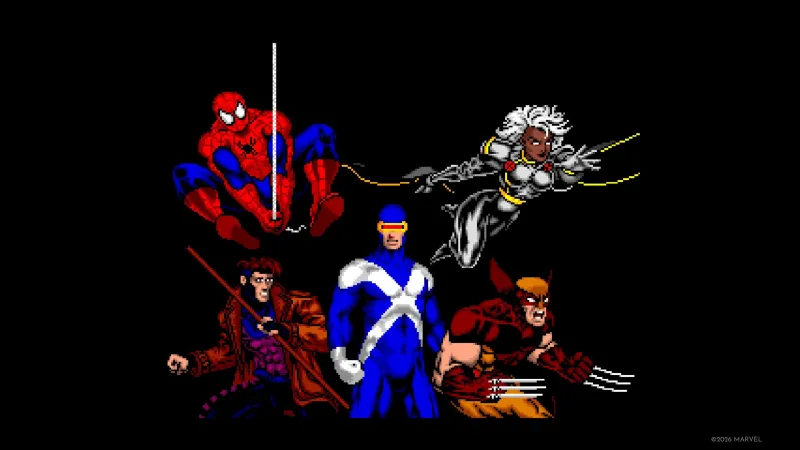
Preserving vintage video games is a delicate balance between maintaining original design and ensuring modern playability. The Marvel Maximum Collection bridges this gap by offering a curated look at the comic book gaming landscape of the ‘80s and ‘90s, highlighting Marvel’s cultural dominance long before the MCU existed. While the compilation is bolstered by thoughtful quality-of-life features, the quality of the games themselves varies significantly.
The Arcade Heavyweight: X-Men
X-Men: The Arcade Game remains the undisputed star of this collection. It perfectly captures the chaotic joy of the 6-player cabinets that once dominated arcades. Players can toggle between different cabinet versions and utilize online multiplayer to recreate those massive, screen-filling battles. The vibrant visuals, iconic (if poorly translated) dialogue, and flashy combat still hold up, making it a fantastic title to revisit or introduce to a new generation.
Captain America and the Console Brawlers
Captain America and The Avengers fails to reach the same heights as the X-Men title. The action lacks impact and the visuals feel less refined. However, the game remains a curiosity for fans of comic book cameos and bizarre level design, ranging from underwater depths to outer space. The inclusion of various platform versions—including the NES iteration—adds historical value, even if the 2D platforming itself is lackluster.
The collection also features Spider-Man/Venom: Maximum Carnage and Venom/Spider-Man: Separation Anxiety. Maximum Carnage stands out with its 16-bit aesthetic and an energetic soundtrack, though it suffers from the limitation of being a single-player experience. Separation Anxiety introduces a two-player mode, but the combat and narrative fail to provide the same visceral thrill as its predecessor.
Frustration and Nostalgia: Arcade’s Revenge and Silver Surfer
Spider-Man/X-Men: Arcade’s Revenge is a bizarre relic. While the concept of navigating levels designed by the villain Arcade—such as Wolverine’s toy-themed stage—is amusing, the execution is hampered by clunky controls and arbitrary, unfair level design. Nostalgia might trigger a brief interest, but the gameplay is largely defined by frustration. While the collection offers various versions, including portable ones, the appeal of playing these through to completion remains questionable.
Finally, Silver Surfer rounds out the package. Often cited for its extreme difficulty, the truth is that the game is mechanically flawed, featuring relentless enemy spawns that result in constant deaths. In this instance, the collection’s built-in cheat features are essential. Activating a “god mode” allows players to appreciate the game’s imaginative cosmic settings and its stellar chiptune soundtrack without the constant threat of instant failure.
The Marvel Maximum Collection succeeds as a historical archive, presenting these titles exactly as they were. However, beyond the classic status of X-Men, the value of this collection leans heavily into nostalgia and a deep interest in the history of superhero gaming. For those who appreciate the evolution of the genre, it provides a solid trip down memory lane.