
EA Tiburon’s Madden NFL 23 marks a pivotal shift for the long-running series, prioritizing core gameplay mechanics and technical stability over superficial additions to deliver a more authentic 11v11 football experience.
FieldSense: Physics-Driven Chaos
The most significant evolution in Madden NFL 23 lies beneath the surface with “FieldSense,” a new system designed to inject physics-based interactions into every play. In practice, the result is largely positive. Running the ball through crowded lanes feels violent and unpredictable, successfully mirroring the intensity of the real-world sport. However, the system is not without its growing pains; defenders occasionally slide off ball carriers as if they were coated in Teflon. While the way defenses engage and ball carriers fight for extra yardage feels authentic, the frequency of fumbles during these exchanges requires further tuning in future patches.
Broadcast-Quality Presentation
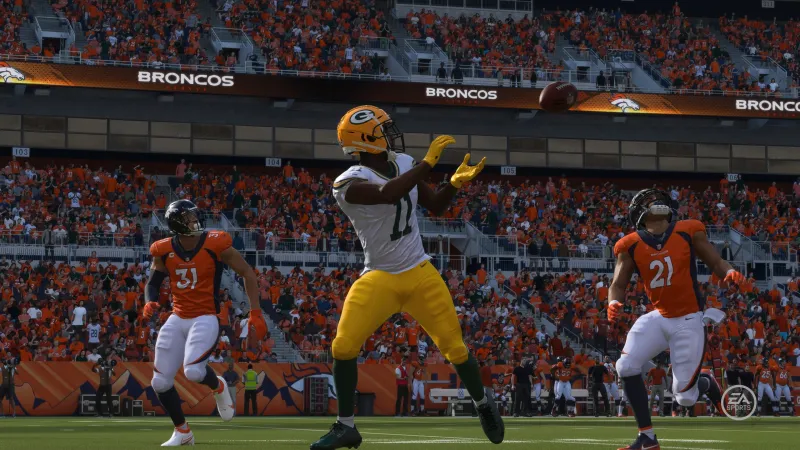
Visually, Madden NFL 23 is a noticeable step up. The game serves as a fitting tribute to the late John Madden, with his legacy woven into the experience from the moment the game boots up. Updated player scans and equipment models look sharp, while the broadcast presentation—complete with vibrant graphical overlays and cinematic camera angles—creates a genuine NFL television feel. The authenticity is compelling enough that skipping transitions becomes less tempting than in previous entries.
Skill-Based Passing: A New Level of Control
The introduction of Skill-Based Passing adds a layer of depth to the air game. While using a target reticle takes time to master, the increased control over ball placement is a game-changer, especially when threading the needle over the middle of the field. Once the mechanics become second nature, it is difficult to return to the older control schemes. Conversely, the new passing meter feels largely redundant; muscle memory remains the primary factor for accuracy, rendering the meter an optional, non-essential feature.
Connected Franchise: Refined Realism
Connected Franchise receives a thoughtful refinement this year, focusing on humanizing the roster through “Motivations” and “Tags.” Motivations force players to consider factors like stadium location or the presence of a star quarterback, influencing free agency negotiations and team-building strategies. Meanwhile, “Tags”—such as the Mentor role—provide tangible benefits by accelerating the development of younger teammates. These additions successfully bridge the gap between pure simulation and the off-field decision-making required of real-world NFL GMs.
Face of the Franchise: A Mixed Bag
The Face of the Franchise mode continues to be an inconsistent experience. While playing as a quarterback, running back, or linebacker remains engaging due to constant involvement, the addition of the cornerback position is a step backward. The lack of impact on plays outside of the player’s immediate vicinity can lead to frustration, particularly when failing to meet goals due to factors beyond the player’s control.
The Verdict on Madden NFL 23
Madden NFL 23 succeeds by doing what the franchise has long needed: rebuilding its foundation. By prioritizing physics-based action and improved ball-placement controls, EA Tiburon has successfully set a new baseline for the series. While core modes received only iterative updates, the focus on gameplay fundamentals makes this a superior entry and a promising platform for future installments.