
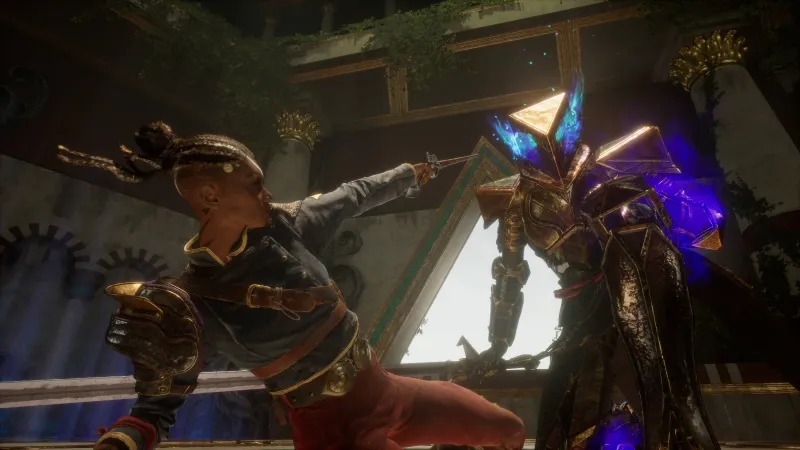
Developer A44’s Flintlock: The Siege of Dawn delivers an ambitious action-RPG that attempts to blend colonial-era tech with high-fantasy combat, but ultimately lands as a respectable yet unpolished experience. While the game provides an engaging premise and a unique combat system, it struggles to reach the heights of its genre peers due to inconsistent execution and technical limitations.
A Unique World Marred by Narrative Gaps
The game drops players into a world where gods and their undead armies have overrun the mortal realm. You play as Nor Vanek, a soldier on a mission to eradicate the divine, aided by Enki, a fox-like deity with his own mysterious agenda. The core premise is undeniably intriguing, and the evolving partnership between Nor and Enki provides the story’s most compelling moments.
However, the narrative falters elsewhere. Supporting characters lack depth, making it difficult to form any real emotional investment. The primary antagonists are equally underdeveloped, serving more as aesthetically pleasing obstacles than genuine threats with clear motivations. Furthermore, uneven sound mixing frequently buries dialogue under the weight of the soundtrack, further hampering the storytelling experience.
Combat: Potential Held Back by Jank
Flintlock features a hybrid combat system that mixes melee axe-work with firearm-based ranged attacks. While the mechanics are functional, the gameplay suffers from a noticeable “jank” factor. Melee strikes and parrying feel mediocre, with inconsistent timing windows that can lead to frustration. Additionally, enemy AI is frequently unconvincing, with foes often failing to detect the player even when in plain sight.
The highlight of the combat is the integration of Enki. By bestowing curses that stun, poison, or weaken enemies, Enki adds a layer of tactical depth. Upgrading his abilities—such as allowing him to restrain foes or imbue your weapons with magical power—is satisfying. Nor’s pistol also serves as a vital tool for interrupting attacks, though other ranged options like grenade launchers and flamethrowers feel underwhelming and rarely worth the inventory space.
Souls-Lite Mechanics and Exploration
Despite borrowing tropes from the “Souls-lite” genre—such as the loss of Reputation (XP) upon death—Flintlock is surprisingly accessible. Boss encounters are rarely challenging, with the final boss proving to be particularly underwhelming. The most innovative mechanic is the Reputation multiplier, which rewards players for varying their combat style. Players must manually bank these points; otherwise, taking damage resets the multiplier to zero, adding a welcome layer of tension to each encounter.
Exploration is largely centered around two medium-sized landmasses filled with sidequests and collectibles. The world itself isn’t particularly vibrant, but the “Rift” system—a network of magic warp points—is a standout feature. These rifts facilitate fast travel and create engaging platforming segments that serve as some of the game’s most enjoyable moments.
Technical Performance and Final Thoughts
Visually, the game is a mixed bag. While some creature designs are creative, the overall presentation feels unrefined. Animations can appear stilted, and the slow-motion kill cam often feels poorly implemented, detracting from the impact of successful headshots. Players are better off sticking to the Performance mode, as the Quality mode offers little tangible improvement.
Flintlock: The Siege of Dawn is not a bad game, but it is one that constantly feels held back by its own scope. It coasts on a line of mediocrity, occasionally showing flashes of brilliance that are unfortunately stifled by technical hiccups and uneven execution. It is a solid, if flawed, revenge quest that stops just short of achieving true greatness.