
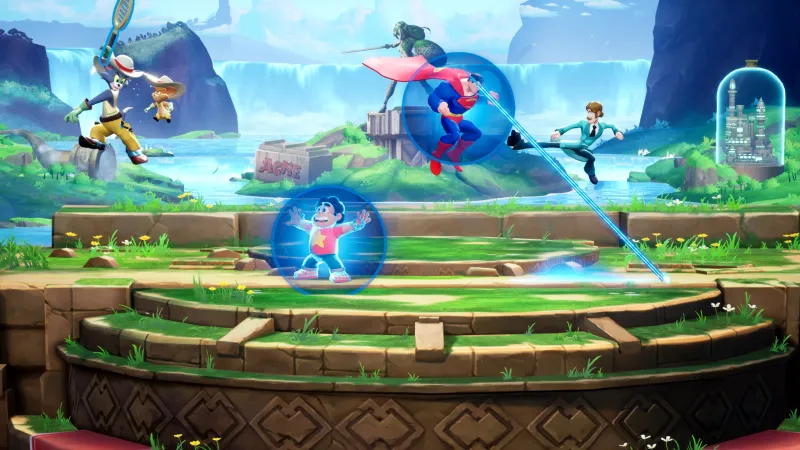
MultiVersus, the latest crossover fighter from developer Player First Games and Warner Bros., successfully challenges the dominance of the Smash Bros. genre by delivering a polished, team-focused experience that respects its iconic roster.
Mastering the Crossover Chaos
While the inclusion of LeBron James—fresh from his role in Space Jam: A New Legacy—might suggest a corporate cash-in, MultiVersus avoids that trap entirely. Each character is treated with genuine reverence, creating a cohesive world where seeing Arya Stark from Game of Thrones trading blows with Bugs Bunny feels surprisingly natural.
The combat mechanics are remarkably tight. The controls translate the heavy, metallic presence of the Iron Giant just as effectively as the frantic, agile movements of Finn the Human from Adventure Time. Every character feels distinct, ensuring that the learning curve remains engaging no matter which fighter you choose to main.
Team Dynamics and the Perks System
Although 1v1 and 4-player Free-For-All modes are available, the game is clearly designed around 2v2 combat. Character classes provide immediate tactical insight; pairing a support-heavy character like Velma, who offers crowd control and buffs, with a powerhouse like Superman creates endless strategic possibilities. You can double down on aggressive playstyles or balance your team to cover individual weaknesses.
The perks system further deepens this strategy. As characters level up, you unlock enhancements for speed, jumping, and dodging. Synergizing these perks with your partner—such as stacking ice-based debuffs—leads to staggering combinations that encourage constant experimentation.
The Technical and Content Landscape
Online performance is stellar, bolstered by robust rollback netcode and a healthy, cross-platform player base. Lag is virtually non-existent, and matchmaking is instantaneous. While I encountered a minor bug where Reindog occasionally turned invisible, technical issues were otherwise non-existent.
However, the game’s stage design is a point of contention. While it’s fun to battle atop the Batmobile in the Batcave, many other arenas, such as generic coliseums or grassy fields, lack the creative flair found in the best Smash Bros. levels. The developer has promised to address the need for more variety with upcoming arcade and ranked modes.
Free-to-Play, Fair-to-Play?
MultiVersus avoids the most predatory pitfalls of the free-to-play model. With a rotating roster and a generous early-game gold influx, players can quickly access a solid portion of the 17-character lineup. Microtransactions are primarily reserved for cosmetics, the Battle Pass, and convenience unlocks, while the practice mode allows players to test every character for free.
The progression loop—driven by daily quests and Battle Passes—provides plenty of goals, though the grind can occasionally feel like a chore. Specifically, the need to play repetitive matches against bots to complete challenges can be a slog, and the UI occasionally struggles to clear completed seasonal goals, requiring tedious menu navigation.
Despite these minor frustrations, MultiVersus is built on a rock-solid foundation. If the developers continue to refine the rough edges and expand the content library, this title has the potential to become a staple of the fighting game genre for years to come.
Note: This review is based on the open beta version of MultiVersus.