
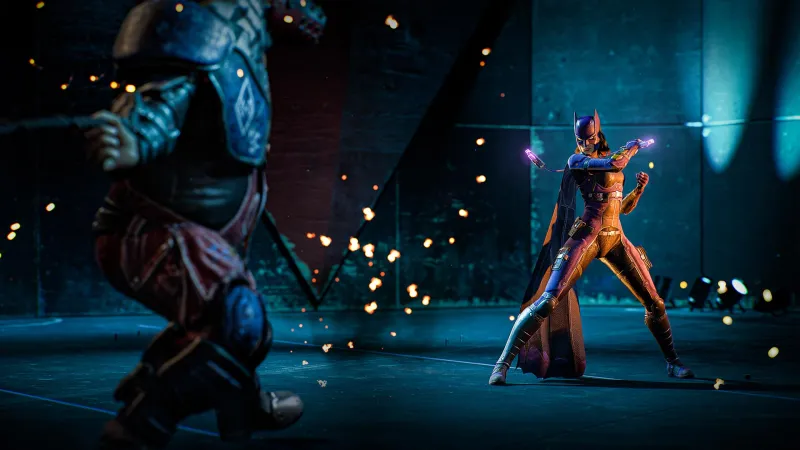
Batman is dead, leaving Nightwing, Batgirl, Robin, and Red Hood to shoulder the burden of defending Gotham City in Warner Bros. Montreal’s latest action title. While the absence of the Dark Knight removes much of the series’ traditional psychological weight, this new generation of heroes successfully anchors a serviceable experience that, while entertaining, struggles to match the high bar set by its predecessors.
Gotham’s Empty Streets and Repetitive Tasks
Though Gotham Knights exists outside the acclaimed Arkham series, its DNA is undeniably similar. Players spend their nights patrolling a sprawling cityscape, stopping crimes and investigating leads. While the freedom to explore is initially promising, the city itself feels surprisingly hollow, lacking the dense, memorable atmosphere that defined previous entries. The map is filled with side activities—from collecting Batarangs to Batcycle races—but these quickly devolve into a checklist of “busy work” that lacks genuine narrative urgency or excitement.
Structured Missions and Iconic Rogues
The game features more structured, linear mission locations that offer a reprieve from the open-world grind. While these encounters don’t always demand the creative problem-solving one might hope for, they succeed in bringing iconic villains to the forefront. Seeing characters like Harley Quinn, Penguin, and the mysterious Court of Owls provides a welcome spark of life to the otherwise formulaic mission design.
Combat Mechanics and the “Batman Jr.” Feeling
Mechanically, the stealth and combat systems are functional but lack the depth and tactical variety of previous predator-style games. Stealth feels limited by a lack of tools, and combat often settles into a repetitive loop of timed button presses. While Momentum abilities add some visual flair and variety, the late-game encounters suffer from bullet-sponge enemies that turn fights into tedious endurance tests. Furthermore, the overall tone often feels like a “Batman Jr.” production; the narrative struggles to match the gravitas expected of the setting, leaving the character dynamics feeling somewhat out of place.
Character Progression and Customization
One of the game’s strongest pillars is its progression system. Players have extensive control over their heroes, with deep ability trees and a fantastic array of suit designs that make tinkering with gear genuinely rewarding. Crafting weapons and applying mods allows for distinct playstyles, with each character—with the possible exception of the slower, ranged-focused Red Hood—feeling unique as you progress through the campaign.
A Seamless Cooperative Experience
Where Gotham Knights truly shines is its cooperative implementation. The drop-in, drop-out system is a technical triumph, allowing two players to fight side-by-side or patrol opposite ends of the city without any performance hitches. The game manages difficulty scaling effortlessly, making it one of the most frictionless multiplayer experiences in recent memory for those looking to clean up Gotham’s streets with a friend.
Ultimately, Gotham Knights does not reinvent the wheel or surpass the legendary status of the Dark Knight’s greatest adventures. However, it manages to be a fun, competent romp that allows players to step into the boots of the Bat-family. While it may not leave a lasting impression, the core loop of uncovering hidden plots and battling Gotham’s worst provides enough satisfaction to make the patrol worthwhile.