
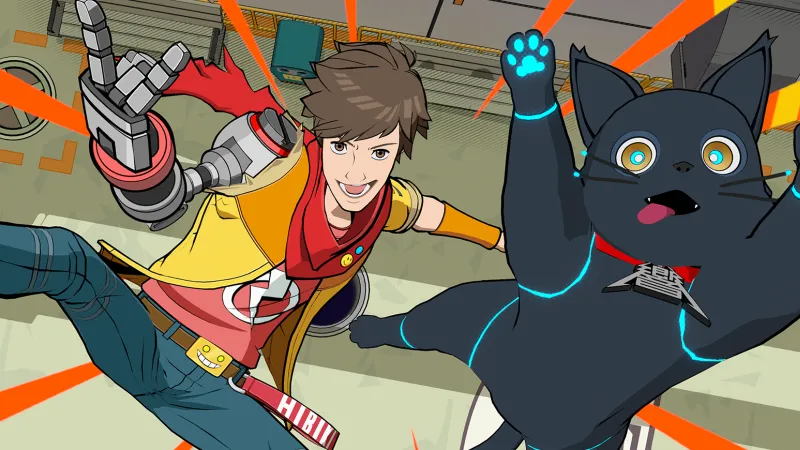
Hi-Fi Rush stands out in today’s landscape of gritty, high-budget titles as a rare, colorful, and unapologetically light-hearted experience. Over its 10 to 11-hour runtime, the game feels more like a Saturday morning cartoon than a prestige television drama, leveraging its unique fusion of rhythm mechanics and stylish action to create something truly special.
A Rockstar Ambition Meets Corporate Dystopia
The story follows Chai, a protagonist with aspirations of becoming a rockstar. His journey begins when he joins Project Armstrong, an initiative by the tech giant Vandelay Technologies. After being labeled a “defect” following a botched arm replacement procedure, Chai must fight his way out of the facility. Along the way, he teams up with Peppermint and a group of disgruntled misfits determined to dismantle Vandelay’s monopoly.
The writing is surprisingly sharp, managing to be intentionally corny without ever feeling grating. Each member of the cast is charming, and the group dynamics—filled with banter and genuine character growth—ultimately become the game’s greatest highlight. By the time the credits roll, the synergy between the cast and the gameplay mechanics feels perfectly aligned.
Satirizing Big Tech and the Gaming Industry
At its core, Hi-Fi Rush is a critique of corporate culture and the gaming industry itself. While it avoids being overly radical, the game takes clever jabs at the massive disparity between marketing and development budgets, as well as the incompetence of managers who prioritize control over quality and safety. Interestingly, this satire comes from Tango Gameworks, a studio owned by the mega-publisher Bethesda Softworks—a detail that adds a layer of irony to the experience.
A World Driven by the Beat
Vandelay’s sprawling corporate campus is a living, breathing environment. Thanks to the cel-shaded art style, the world is constantly in motion, with every element—from industrial gears to character animations—synced perfectly to the game’s internal metronome. Even minor details, such as weapon swings producing guitar squeals that match the key of the background music, highlight the developer’s meticulous attention to detail.
Rhythm-Infused Combat Mechanics
Combat functions like a traditional stylish action game, reminiscent of Bayonetta or Devil May Cry, but with a rhythmic twist. While you can hack and slash to build combos, timing your attacks to the beat of the soundtrack significantly boosts your effectiveness and score. Landing heavy hits in sync with the snare drum or a guitar riff provides a satisfying tactile weight to every encounter.
The licensed soundtrack is essential to this experience. Featuring tracks from Nine Inch Nails, Fiona Apple, and The Joy Formidable, the music carries the weight of the game’s most dramatic moments. While the game starts slightly slow, with a noticeable lack of combat in the early levels, it finds its stride after a few hours, eventually crescendoing into a spectacular, high-energy spectacle.
Accessibility and Design Choices
Hi-Fi Rush is designed to be inclusive for all players. You are not strictly required to fight on the beat to succeed; animations remain visually impactful even if your timing is slightly off. Additionally, the inclusion of a visual metronome and a moderate, consistent tempo throughout the soundtrack ensures that players who struggle with rhythm can still enjoy the experience without feeling overwhelmed.
Given that the game was announced and released on the same day, Hi-Fi Rush is arguably one of the most surprising and successful titles of 2023. By striking a perfect balance between rhythm mechanics, stylish action, and character-driven storytelling, it proves that there is still plenty of room for lighthearted, creative adventures in the modern gaming industry.