
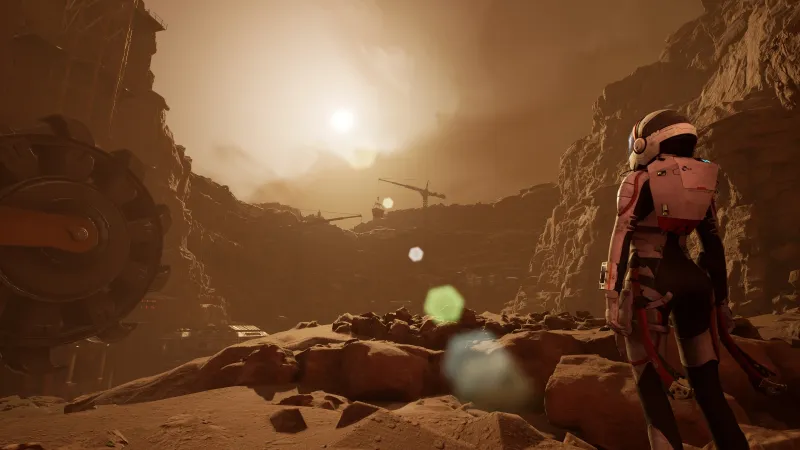
Deliver Us Mars, the ambitious sequel to the acclaimed Deliver Us The Moon, arrives as a title defined by a masterful narrative that frequently struggles to overcome its own technical and mechanical inconsistencies. While the game expands the scope of its predecessor, this increased scale unfortunately amplifies the issues that hold back an otherwise captivating journey across the Red Planet.
A High-Stakes Mission to Save Humanity
You do not need to have played the original game to dive into the plot of Deliver Us Mars. The story follows a near-future Earth suffering from irreversible environmental collapse. Humanity’s only salvation lies in mysterious transmissions from Mars, revealing the location of “Arks”—advanced vessels stolen years prior by a rogue group of scientists. As Kathy, a prodigious young astronaut, you join a desperate mission to retrieve these ships. However, the mission is deeply personal: Kathy’s own father, Issac, was one of the leaders who abandoned Earth, leaving her behind.
Compelling Drama Amidst Technical Flaws
The core of the game is its exploration of the complex, loving, yet fractured relationship between Kathy and her father. This emotional anchor, combined with the mystery surrounding the fate of the Mars colony, creates a narrative drive that keeps players invested despite the game’s presentational shortcomings. The script tackles heavy themes regarding human morality and the consequences of self-destruction with genuine weight.
However, this stellar storytelling is often undermined by subpar presentation. The character models are frequently stilted and awkward, creating a disconnect that detracts from the high-quality voice acting. Furthermore, the Martian environment, while conceptually awe-inspiring, suffers from persistent texture issues and environmental pop-in that can break immersion.
Puzzles and Platforming: Functional but Underbaked
The gameplay loop relies heavily on environmental puzzles and traversal, but both areas hover between “acceptable” and “frustrating.” Much like in the first installment, you alternate between controlling Kathy and her robotic drone companion to manipulate light beams and unlock pathways. While these puzzles provide a decent challenge early on, they lack variety, and the beam-alignment mechanic loses its luster well before the credits roll. A recurring hologram decryption minigame serves as the only other significant mental hurdle.
The Challenges of Martian Traversal
Platforming takes center stage as Kathy uses climbing axes to scale vertical surfaces. Using the left and right triggers to simulate the physical act of climbing is an interesting choice, yet it often feels tedious. The mechanics lack the necessary polish for precision, leading to unresponsive inputs during intense moments. Navigating between climbing patches can be particularly unforgiving, and the game’s occasional attempts to introduce hazards like spinning blades feel poorly tuned for the current control scheme.
Ultimately, Deliver Us Mars is a mixed experience. Much like the cobbled-together shuttle the protagonists use to reach their destination, the game manages to get the job done, but the ride is far from smooth. It is a title that shines brightest when it allows you to absorb its story, even if you are forced to stumble over several design craters along the way.