
Octopath Traveler II successfully recaptures the magic of the SNES golden era while pushing the turn-based genre forward, proving that modern design and classic spirit can coexist seamlessly.
A Refined Evolution of the Formula
On the surface, Octopath Traveler II might appear to be a carbon copy of its predecessor. Players select one of eight unique adventurers, recruit the remaining seven, and slowly untangle their loosely connected narrative threads. However, the sequel delivers a significantly more profound experience; through refined storytelling and complex character development, it feels like the true realization of what the original game aimed to achieve.
Character Depth and Narrative Nuance
Even narratives that lean into familiar tropes are elevated by enough nuance to remain compelling. Take Osvald, for instance; his tale of revenge is standard, but his internal brokenness—expressed primarily through internal monologues—adds a layer of gravity rarely seen in the genre. Similarly, Ochette’s journey involves an ancient world-ending threat, but it is grounded by the weight of deep-rooted racism against her people. Despite this depth, the world can still feel like an “RPG playground” rather than a living ecosystem, as players can commit violent robberies across entire cities without facing any tangible consequences.
Combat Mechanics and Latent Powers
The core combat remains familiar, utilizing the satisfying system of exploiting enemy weaknesses to break their shields and stun them. Players must still manage boost points to maximize damage and experiment with secondary job classes to create hybrid warriors. Square Enix has introduced welcome tweaks, most notably the “Latent Power” system—a character-specific ability that augments skills in high-impact ways. These adjustments, combined with better-balanced encounters, keep the combat feeling fresh and rhythmically tense.
Exploration and the Day/Night Cycle
The introduction of a day and night system adds more than just visual flair; it streamlines leveling by spawning stronger monsters after dark. The map design is a massive improvement over the original, packed with secrets in every corner. Whether it is a hidden dungeon, a secret job, or a long-abandoned village with a unique nighttime questline, the game rewards curiosity at every turn.
Visual Grandeur
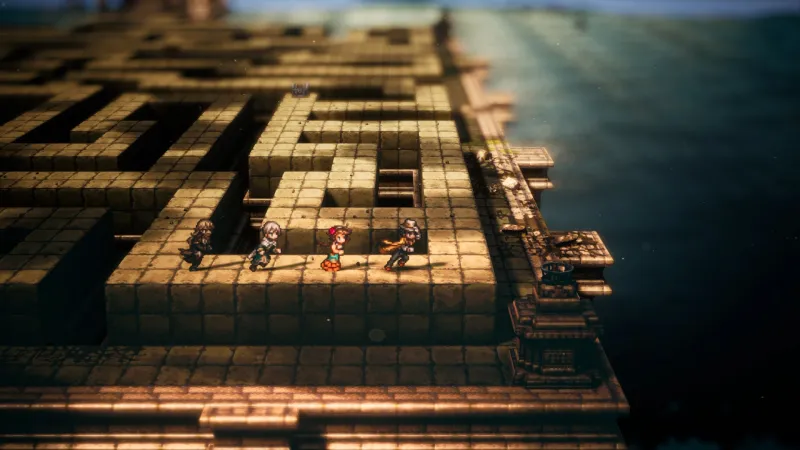
Square Enix’s signature HD-2D aesthetic has evolved significantly. The environments are now richer and more detailed, benefiting from the removal of the heavy blur filter that obscured the edges of the screen in the first game. The result is a vibrant, gorgeous world that feels truly immersive.
Ultimately, Octopath Traveler II accomplishes exactly what a stellar sequel should: it improves upon its predecessor in nearly every measurable way. While certain areas remain slightly stiff, the game stands as a confident, sterling achievement in the RPG landscape.