
Atari’s long-lost 1980s arcade prototype, Akka Arrh, has finally been resurrected for modern consoles by legendary designer Jeff Minter. Tasked with reimagining a project that was originally scrapped due to lack of interest—with only three original cabinets ever confirmed to exist—Minter has infused the title with his signature psychedelic flair. While this revival offers moments of arcade brilliance, the experience is frequently undermined by a cluttered visual design that makes the high-octane gameplay difficult to parse.
Mastering the Chaos of the Chain
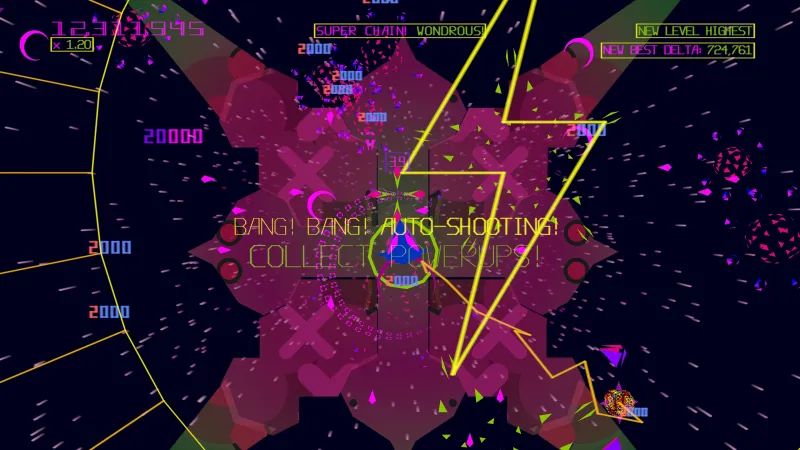
At its core, Akka Arrh is a top-down shooter where players defend themselves against waves of abstract, geometric enemies. The gameplay loop revolves around a strategic balance of bombs and bullets: bombs trigger chain explosions that clear basic foes and grant you bullets, which are then required to dismantle stronger enemies immune to explosive damage. When you successfully chain a massive explosion across the screen, the game feels electric. Watching geometric shapes disintegrate as humorous, ever-changing text scrolls at the top of the screen provides a satisfying, high-energy arcade loop.
High Difficulty and Modern Adjustments
True to its 1980s roots, Akka Arrh is punishingly difficult, even on its normal setting. Because the game was designed for an era where high-skill ceilings kept players pumping quarters into machines, it demands precision. To accommodate modern players, the developers have implemented a convenient save system for your highest scores per level, allowing you to bypass the traditional arcade grind. However, even with the ability to jump into specific stages, the game remains a steep challenge; having full health and a surplus of bullets is often not enough to save you from a poorly timed mistake.
The Camera and Visibility Problem
A significant point of frustration is the camera system, which follows your cursor to allow for free-roaming movement. While this provides mobility, it often causes enemies and incoming projectiles to spawn off-screen while you are occupied elsewhere. This lack of peripheral awareness is exacerbated when using long-range power-ups; you might inadvertently destroy an enemy that triggers a screen-wide projectile upon death, ending your chain instantly. In a game that demands constant focus, losing a high-score run to factors outside your direct field of view feels unfair.
Visual Noise vs. Necessary Information
The game’s art direction leans heavily into a flashing, psychedelic aesthetic. While there is a settings toggle to disable the most intense flashing for sensitive players, the real issue lies in the balance of information. As your chain grows, the screen is flooded with swirling text, massive symbols, and explosive effects. This visual “noise” often obscures vital gameplay data, such as your current health or active power-up status. The design is undeniably ambitious, but it frequently prioritizes style over the clarity required for such an intense, fast-paced shooter.
A Steep Learning Curve
Despite the high production value evident in the enemy designs and audio cues, Akka Arrh suffers from a lack of immediate readability. Abstract visual cues—such as a red flashing screen or a pulsing sine wave—are not clearly explained, leaving players to decipher their meaning through trial and error. While these mechanics are not impossible to learn, the onboarding process is unnecessarily steep. For a game marketed with “modernized mechanics,” the barrier to entry remains surprisingly high.
Ultimately, Akka Arrh serves as a fascinating historical experiment. It is a treat to see a lost piece of gaming history brought back to life, but the final product comes with a significant caveat. While Atari fans will likely find enjoyment in its nostalgic roots, the overwhelming visuals and abstract design choices prevent the game from reaching its full potential.