
EA Sports PGA Tour marks a return to professional golf, but the experience is marred by an inconsistent simulation engine that struggles to define its own identity. While the game boasts stunning visuals and the best interactive presentation in the sport, the actual on-the-course gameplay frequently delivers frustrating and unpredictable results.
Presentation Excellence Meets Gameplay Friction
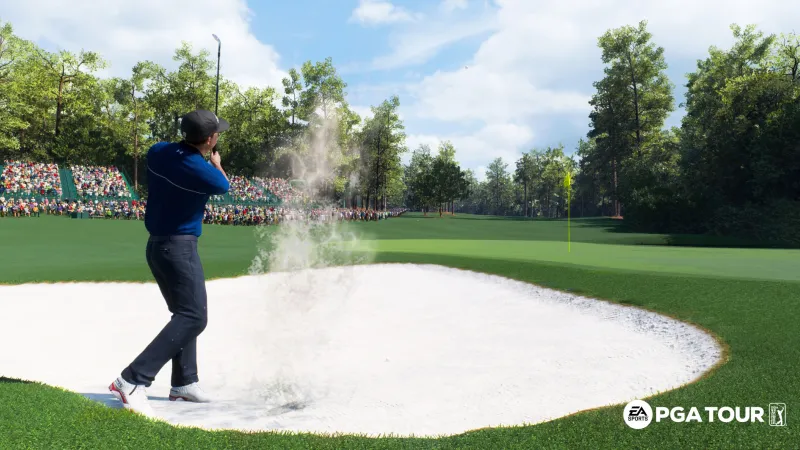
In terms of licensing, EA secures a major victory by featuring the Masters and iconic venues like Pebble Beach. The presentation is top-tier; the Masters’ opening day is celebrated with authentic tee shots from legends like Jack Nicklaus, and the commentary remains thoughtful and unobtrusive during hole flybys. The courses themselves are visual masterpieces, where every blade of grass is rendered in high definition. However, this immersion breaks when hitting spectators with a ball, as the crowd shows zero reaction to being struck.
The Steep Challenge of a Punishing Sim
The game demands perfection, as fairways and greens often feel locked to their most punishing settings. While the analog stick swing mechanics are logical in theory, the lack of clear feedback makes it difficult to diagnose why a shot slices into the trees. Every stroke accounts for a complex mix of backswing speed, loft, length, and wind. Because the game provides little insight into what specifically caused a botched shot, players are left without a clear sense of how to improve their performance.
Inconsistent Mechanics and Aiming Issues
When the ball is in flight, a small window displays the analog stick’s motion, revealing that even the slightest deviation leads to a drastic error. While leveling up provides marginal relief, the putting mechanics remain problematic. The game provides a guide for ball tracking, but it lacks the necessary context to help players understand how that line translates to actual aiming. Even on the easiest difficulty, a minor lapse in power or alignment results in a missed putt.
Identity Crisis: Arcade Roots vs. Modern Simulation
EA Sports PGA Tour remains tethered to the legacy of the retired Tiger Woods series. Features like button-mashing for power during the backswing and adding spin to a ball in mid-air feel jarringly unrealistic. The title is clearly caught in an identity crisis, struggling to find its footing between the arcade-style mechanics of its past and the rigorous simulation standards set by rival 2K Sports.
Career Mode and the Grind for Progress
The single-player career mode is limited by a lackluster character creator, offering only generic appearances and a sparse selection of clothing. Progression is equally unrewarding; while early XP gains are rapid, the final stat tiers require an agonizingly slow grind. The game frequently nudges players toward spending between $5 and $50 on in-game currency to purchase cosmetics or stat-boosting gear, making the slow progression feel like a deliberate push toward microtransactions.
Technical Hurdles and Design Flaws
Training challenges, intended to help players earn XP and sponsorships, are tedious and clumsy, forcing constant back-and-forth between gameplay and loading screens. Furthermore, the game’s graphical fidelity occasionally hinders play. Obstructions like spectators or translucent tall grass can block the swing meter, turning a difficult shot into an unfair guessing game.
Unlocking Basic Skills
The leveling system introduces specific swing types, such as power drives, which function similarly to Madden’s X-Factors. While these additions aim to spice up the gameplay, they feel out of place in a title striving for realism. It is particularly illogical that players must unlock basic shot types that should be fundamental to a professional golfer’s repertoire.
Ultimately, EA Sports PGA Tour succeeds in capturing the intricate nuances of the sport, but the mechanics fail to translate those nuances into a satisfying user experience. By failing to commit to either pure realism or arcade accessibility, the game lands its opening drive firmly in the rough.