
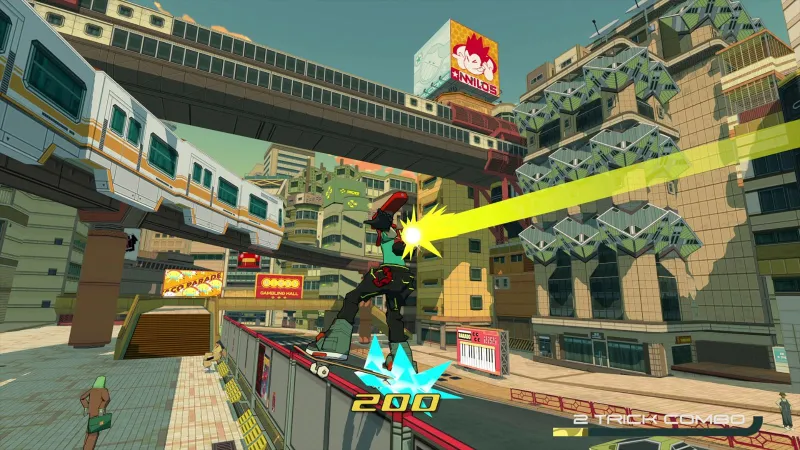
Bomb Rush Cyberfunk arrives as a direct spiritual successor to Sega’s cult classics Jet Set Radio and Jet Set Radio Future, attempting to reclaim the glory of early 2000s Japanese street culture through rollerblading, graffiti, and electronic beats. However, by relying entirely on nostalgia rather than innovation, the game struggles to establish an identity of its own, ultimately feeling like a derivative tribute that leaves players wishing they were playing the original inspirations instead.
An Earnest Homage or a Blatant Copycat?
To understand Bomb Rush Cyberfunk is to understand its influences. Much like its predecessors, the game tasks players with controlling a graffiti-tagging gang navigating the streets of New Amsterdam. Whether you are on rollerblades, a skateboard, or a BMX bike, the gameplay loop remains identical to the Sega titles: terrorize the city, tag every available surface, and battle rival gangs for territory. While the game functions as a sincere homage, it often crosses the line into being a copycat with few original ideas to offer.
Momentum and Mechanical Limitations
There are moments where the game excels. Action sports titles live and die by their sense of momentum, and chaining together million-point combos through New Amsterdam feels fluid and satisfying. The tagging mechanic, which briefly shifts into a drawing-based minigame, adds a layer of flair to the traversal. However, the experience never truly challenges the player. The absence of a balance meter makes grinding or manualing effortless, leading to a lack of skill progression. After about eight hours, the mission structure—tag, compete in a combo contest, and engage in lackluster combat—becomes increasingly monotonous, save for the occasional dream-sequence levels that finally push the player’s abilities.
Aesthetic Success, Narrative Failure
Visually, the game is a triumph. By adopting the cel-shaded aesthetic of the early 2000s, Bomb Rush Cyberfunk pops off the screen with vibrant energy. The soundtrack is equally strong, featuring contributions from Hideki Naganuma, the legendary composer behind the original Jet Set Radio. Yet, the limited playlist means your favorite tracks will quickly become repetitive. Furthermore, the game is hampered by a miserable, boring story that serves as little more than a hollow backdrop for the action.
The Pitfall of Nostalgia-Driven Design
The primary issue with Bomb Rush Cyberfunk is its obsession with its own inspiration. It is impossible to discuss the game without constantly drawing comparisons to Jet Set Radio, which highlights a recurring problem in modern media: the tendency to prioritize memory over innovation. While Jet Set Radio felt unique and daring two decades ago, Bomb Rush Cyberfunk feels like a recycled product that offers nothing new to the conversation. It is a fun game trapped in a hollow shell—one that is content to repeat the past rather than create new, meaningful memories for the player.