
Tides of Tomorrow transforms the genre of choice-driven narrative games by introducing a revolutionary “ripple effect” mechanic where every action you take leaves a tangible, persistent impact on the world for future players. Developed by Digixart, this first-person sci-fi experience uses its innovative multiplayer integration to turn global themes of climate change and conservation into deeply personal, mechanical realities.
A Shared World of Consequences
In Tides of Tomorrow, you play as a “Tidewalker,” individuals who possess the unique ability to see the recent memories of others who have traveled the same path. Before embarking on a mission, you select a predecessor—a real player who has already completed the level. Their previous actions dictate your current reality: if they angered powerful NPCs, guards will be more hostile toward you; if they were charismatic, you may be treated as a welcomed omen. This isn’t merely a superficial gimmick; it makes the world feel vibrant, reactive, and perpetually caught in the middle of a shifting conflict.
Beyond the Narrative: Mechanics of Altruism
The game’s connection to others extends through a sophisticated emote system and resource-sharing mechanics. You can leave behind spoils for future travelers or stow away resources in special chests, turning the act of playing into a gesture of goodwill. This design choice reinforces the game’s core message: preserving the environment and resources for the next generation. It is a refreshing departure from typical online games that encourage dominance, instead offering a rare, satisfying experience centered on kindness and community.
Survival in a Plastic-Choked Future
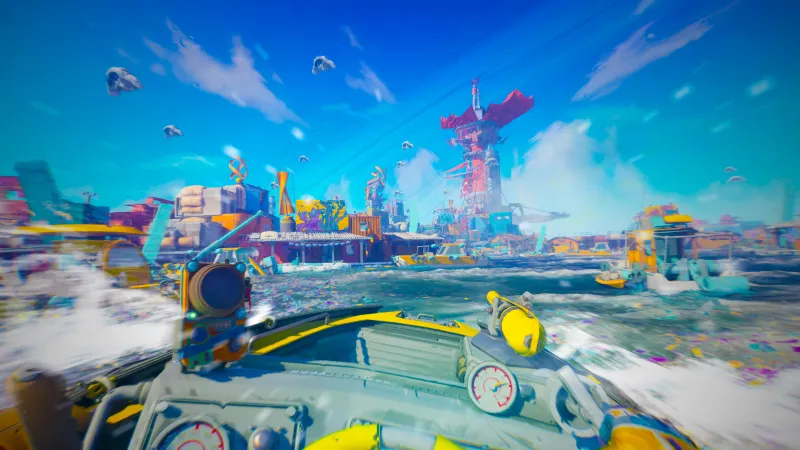
The setting is a haunting, flooded Earth defined by the scarcity of resources and the overwhelming presence of plastic waste. This environmental collapse has birthed “Plastemia,” a disease turning human bodies into plastic. Players must manage their health through an inhalant called Ozen. Because Ozen is both a life-saving necessity and a critical narrative tool, the game forces you into agonizing moral dilemmas: do you save yourself, or do you sacrifice your health to help someone else? This integration of a survival meter into narrative tension is highly effective.
Gameplay Variety and Thematic Depth
While the core narrative is engaging and well-written, the true star is the storytelling method itself. The gameplay loop is varied, incorporating stealth sequences, light platforming, puzzle-solving, and vehicle segments like boat and submarine navigation. While none of these individual mechanics are groundbreaking on their own, the game’s pacing ensures you are never stuck performing one task for too long, keeping the experience fresh from start to finish.
Ultimately, Tides of Tomorrow succeeds because it aligns its mechanics perfectly with its philosophy. By physically seeing how my predecessors shaped the world, I felt a genuine responsibility to protect it for whoever followed in my footsteps. It is a clever, meaningful take on narrative consequences that reminds us why video games remain a uniquely powerful medium for storytelling.