
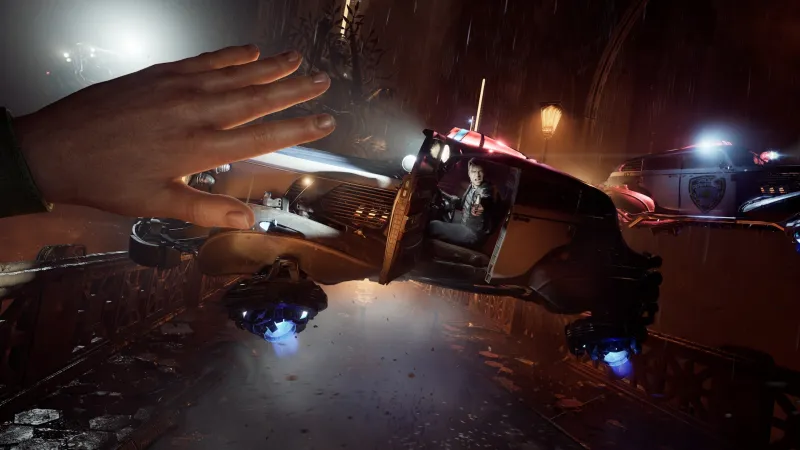
Nobody Wants to Die is a chilling, narrative-driven detective thriller set in a 2329 New York City where immortality is a commodity, forcing players to navigate a grim, high-stakes murder mystery. Developed by Critical Hit Games, this first-person adventure explores the dark consequences of a society where consciousness can be transferred between bodies, turning life into a subscription-based service controlled by the government.
A Visually Stunning Cyberpunk Metropolis
Since the release of 1982’s Blade Runner, cyberpunk aesthetics have become a staple of science fiction. However, Nobody Wants to Die distinguishes itself through a breathtaking fusion of Art Deco and futuristic technology. The game imagines a world where tech evolved rapidly in the 1930s, resulting in a concrete jungle filled with vintage flying cars and Tomorrowland-inspired gadgets. With top-tier graphical fidelity and atmospheric lighting, it stands as one of the most visually striking games of the year.
Immortality and Orwellian Control
The world-building goes far beyond surface-level visuals. Humanity has conquered death by transferring consciousness into new vessels, but this “gift” comes with a heavy price: citizens must pay recurring fees to retain their bodies. Those who cannot afford the subscription face seizure by the government, leaving their minds trapped in memory banks for decades. Critical Hit Games excels at weaving this lore into the environment, from Orwellian propaganda posters to radio broadcasts that flesh out the disturbing reality of this society.
Detective Work in a High-Stakes Mystery
Players step into the shoes of James Karra, a 120-year-old detective tasked with solving the murder of an elite figure. The gameplay centers on high-tech forensics: using X-rays to track bullets, UV lamps to uncover blood trails, and a time-manipulating gauntlet to reconstruct chaotic crime scenes. While the investigation mechanics are more about thorough exploration than complex deductive reasoning, the process of piecing together the narrative remains satisfying.
Choice-Driven Narrative and Character Dynamics
The core of the experience lies in the relationship between James and his remote partner, Sara. Their banter provides much-needed levity, and the voice performances make their connection feel genuine. The game also features significant decision-making moments—ranging from minor character choices to pivotal moral dilemmas—that can alter the direction of the plot. While the lack of a chapter selection makes replaying the five-hour journey to see different outcomes a bit tedious, the branching paths add meaningful stakes to the dialogue.
A Gripping Story with Minor Pacing Issues
The narrative juggles three distinct threads: the primary murder case, James’ personal trauma regarding his wife’s death, and a compelling arc involving Sara. While the story is consistently engaging and filled with twists, it can occasionally feel disjointed, shifting focus away from the main mystery just as the tension peaks. Furthermore, the central antagonist remains somewhat obscure, leaving some questions unanswered by the time the credits roll.
Despite these minor flaws, Nobody Wants to Die delivers a tight, compelling experience that respects the player’s time. It concludes just before its repetitive forensic loops wear out their welcome, leaving behind a memorable, cautionary vision of a future we hope never comes to pass.