
Madden NFL 25 delivers a refined gridiron experience with improved physics and deeper franchise management, though the title ultimately plays it safe rather than reinventing the franchise. Despite consistent incremental gains, the game struggles to break free from the stagnation that has plagued the series in recent years, resulting in a polished but predictable annual entry.
Gameplay Mechanics and On-Field Authenticity
Stepping up to the line of scrimmage in Madden NFL 25 feels more strategic than ever thanks to expanded playbooks, refined audible options, and granular route adjustments. Once the ball is snapped, the action on the field mirrors real-world NFL dynamics. Quarterbacks like Lamar Jackson, Patrick Mahomes, and Josh Allen possess distinct playstyles that accurately reflect their unique capabilities under pressure.
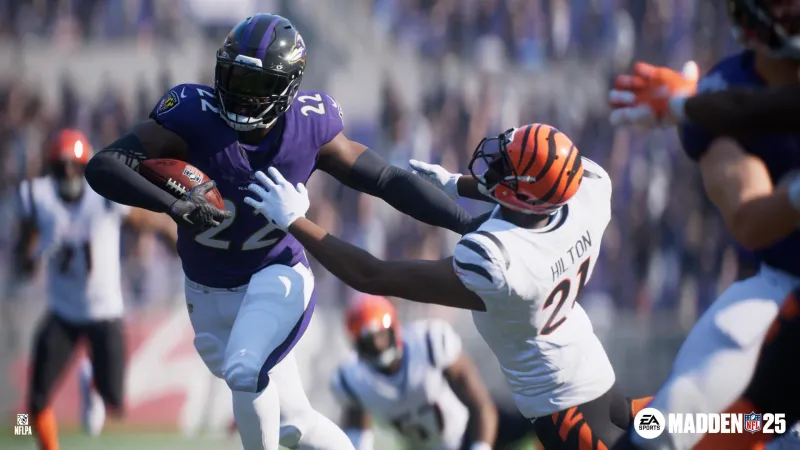
The introduction of improved physics and contact animations significantly elevates the realism of tackles and blocking. Offensive line interactions are smoother, reducing the frustrating “stuck” animations of the past and creating more viable pockets and running lanes. While occasional scripted sequences involving receivers and quarterbacks persist, the overall tactical depth is a clear step forward.
The X Factor: Superstar Differentiation
Madden NFL 25 continues to master the art of separating elite talent from the rest of the league through its X Factor system. By granting unique, game-changing abilities to superstars, the game successfully creates mismatches that go beyond simple attribute ratings. Whether it is Mike Evans dominating single coverage or Marshon Lattimore excelling in contested catch situations, these refinements make high-profile players feel truly impactful on every down.
Presentation and Immersion Challenges
Visually, Madden NFL 25 is a gorgeous representation of the sport. Player models are highly authentic, and the broadcast-style graphics effectively mimic the television experience. The addition of new commentary teams is a welcome change to combat the repetitive dialogue of previous years. While these new duos lack the polish of the veteran team, it is a positive foundation for future growth.
However, immersion is frequently interrupted by technical hiccups. Broadcast graphic glitches, jarring pre- and post-play animations, and instances where the ball appears “glued” to a player’s hand detract from the simulation’s otherwise high-fidelity presentation.
Career Modes: Progression vs. Monetization
The Superstar career mode introduces a compelling quest-based system that adds an RPG-lite layer to player progression. I enjoyed the clear, goal-oriented interface that tracks objectives at the start of each drive. Unfortunately, this mode is marred by a persistent push toward monetization. The game frequently nudges players toward the online-focused Showdown mode, utilizing in-game quests and constant prompts to engage with microtransactions, emotes, and boosts.
Franchise Mode: A Strategic Win
For those who prefer the business side of the NFL, Franchise mode remains the standout experience. EA Tiburon has clearly prioritized this area, delivering improved menus, cinematic elements, and more engaging storylines. While the production values of dialogue sequences could be higher, the overall management suite is a massive improvement over the neglected state of the mode just a few years ago. Taking the reins of a team to navigate drafts and trades remains the most rewarding way to play.
Final Verdict
Madden NFL 25 avoids “Hail Mary” risks in favor of consistent, small-yardage gains. While it lacks the explosive innovation that would launch it into the highlight reels, it remains a reliable and effective entry in the series. It successfully moves the chains, but the franchise continues to play it safe, leaving fans waiting for a truly revolutionary leap forward.