
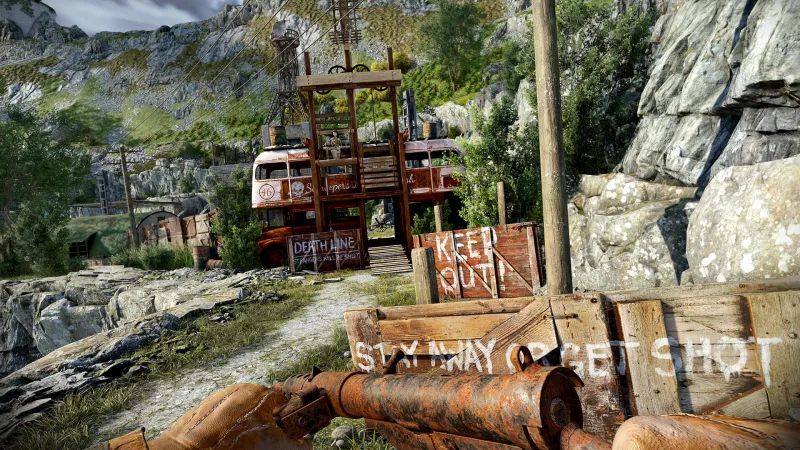
Atomfall is an open-world survival shooter that thrives on friction, challenging players to earn their success through deliberate, often grueling gameplay. Developed with the intent of creating a high-stakes struggle, the title succeeds in its core mechanics—exploration, survival, and quest design—but falters significantly due to a lackluster progression system and a thin, unengaging plot.
A Disconnected Narrative Experience
The game’s approach to storytelling leaves players feeling like distant observers rather than active participants. You begin the journey within the quarantine walls with no memory of your past and no established connection to the world, which strips the protagonist of any compelling motivation. Consequently, completing tasks—whether rescuing prisoners or eliminating threats—feels like a chore driven by vague curiosity rather than genuine narrative investment. Even the primary quest-giver, a disembodied voice on a telephone, fails to provide a satisfying arc or a concrete resolution by the time the credits roll.
Interaction with the world is equally cold. NPCs in areas like Wyndham offer little beyond blank stares, and the lack of dialogue options forces players to treat civilians as nothing more than obstacles to be knocked out. Without meaningful NPC engagement, the world feels hollow, relying too heavily on scraps of paper found on corpses to deliver lore.
Strategic Exploration and Survival
Atomfall truly shines when it focuses on the mechanics of survival and exploration. By utilizing sectioned-off open areas rather than one massive, sprawling map, the game maintains a focused scope. Objectives are not spoon-fed to the player; instead, you must rely on environmental clues and detailed notes to navigate to landmarks, encouraging a more observant and critical playstyle.
The survival loop is equally demanding. Resources are scarce, forcing players to scavenge corpses, craft essential items, or barter with rare traders. The real-time nature of the inventory menu—where healing, reloading, and crafting occur without pausing the game—creates constant tension. Hiding in a corner to frantically craft a grenade while under fire is a standout experience in high-stakes immersion.
Gunplay and Combat Balance
The shooting mechanics in Atomfall are visceral and rewarding. Weapons like shotguns and rifles demand constant reloading, making every bullet feel precious. The minimalist HUD, which requires players to visually inspect the gun’s chamber to check ammunition, is a fantastic touch that reinforces the game’s gritty atmosphere. While combat is punishingly difficult—often ending in death after just a few hits—the game provides robust accessibility options to help players tailor the difficulty to their skill level.
The Stealth Dilemma and Progression Flaws
Unfortunately, the game struggles when players attempt a stealth-based approach. The lack of reliable hiding spots, combined with enemy AI that possesses eagle-eyed detection, makes sneaking nearly impossible. Even basic takedowns often alert nearby guards, rendering subtle playstyles ineffective. This forces players into head-on combat, which can quickly become an exercise in frustration due to the game’s brutal difficulty spikes.
The progression system further complicates matters. Skills are locked behind rare training manuals found in the wild, and because these categories remain hidden in the upgrade menu until the manual is discovered, players may accidentally miss vital trees—such as stealth or inventory management—for the entire game. This lack of transparency makes character growth feel inconsistent and occasionally unfair.
Atomfall possesses a unique, exciting core, but it is frequently obscured by design frustrations. While the shooting and survival elements offer a satisfying challenge for those willing to brave the difficulty, the underbaked stealth mechanics and narrative gaps prevent it from reaching its full potential.