
Light Brick Studio’s LEGO Voyagers delivers a heartwarming, strictly co-op puzzle platformer that mirrors the collaborative joy of building a physical LEGO set with a partner. While its distant camera and visual filters occasionally hinder the experience, the wordless, emotional storytelling and inventive two-player mechanics make this brief journey a standout addition to the couch co-op genre.
A Strictly Two-Player Experience
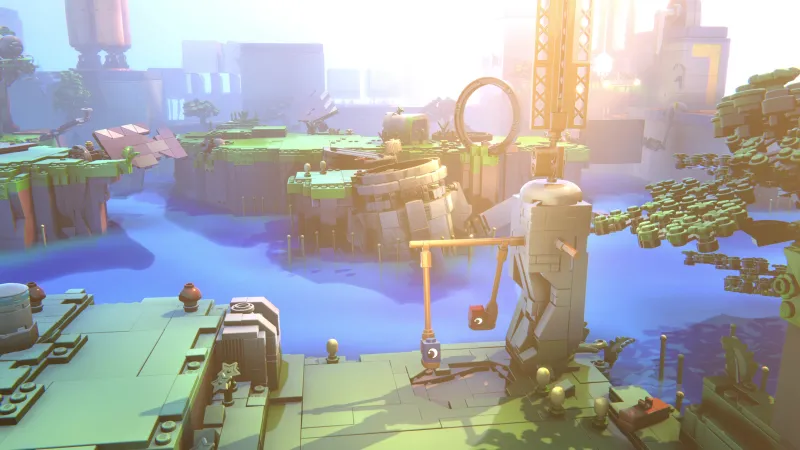
Much like It Takes Two or Split Fiction, LEGO Voyagers is designed exclusively for two players, meaning solo play is not an option. Fortunately, for those without a local partner, the game includes a “Friend’s Pass,” allowing you to team up with someone online for free. The core gameplay revolves around two LEGO pieces—one red, one blue—traversing a world constructed entirely from digital bricks. From intricately detailed mountains to minimalist butterfly silhouettes, the aesthetic is consistently charming. A dedicated “speak” button adds personality, allowing your characters to babble in gibberish or, in one delightful train-themed segment, chirp a literal “choo choo.”
Building and Collaboration Mechanics
The gameplay loop balances puzzle-solving with platforming. Players can lock onto stud-covered surfaces for precision movement or pick up loose bricks to construct bridges and ramps. While the early-game building projects are somewhat repetitive, the final act introduces significantly more creative challenges. The highlight, however, is the vehicle-based puzzle design. Requiring one player to steer while the other manages acceleration, these moments emphasize the necessity of the game’s forced co-op structure.
Platforming Challenges and Camera Frustrations
The platforming elements are the game’s weakest link. Because the camera is fixed at a distant, angled perspective to showcase the environment, depth perception becomes a frequent issue. Navigating narrow, single-stud platforms often feels unnecessarily difficult due to this camera distance combined with heavy visual bloom effects. While the game is forgiving regarding player death, these technical hurdles suggest the experience is better suited for children aged 10 and up rather than very young players, despite the accessible visual style.
A Bittersweet Narrative Triumph
Despite the platforming frustrations, the narrative payoff is exceptional. The story begins vaguely but evolves into a stunning, bittersweet tale that culminates in one of the most effective storytelling moments of the year. The abstract nature of the narrative encourages players to fill in the gaps themselves, fostering a unique connection between the two partners as they develop their own shorthand and strategies to navigate the world.
Ultimately, LEGO Voyagers succeeds because it prioritizes the relationship between the players. While an adjustable camera or graphical settings would have been welcome additions, the core experience—building a shared journey with a friend or loved one—is what makes this title truly memorable.